


Fanuc Servo Motors: All the Information You Need to Know
By Paul Lee, Product Manager, Motors & Drives, FANUC America
Picking the right type of motor for your application is an important step in ensuring you will get the performance your operations need. In the processing world, motors are the powerhouse of your plant floor, so understanding the choices available to make the correct decision will help keep your facility running smoothly.
With many manufacturing processes becoming increasingly automated, demanding accuracy and needing repeatability, servo motors are an excellent option. Unlike hydraulic pumps or induction motors that must remain on while in use, servo motors are switched on and off during their operation resulting in significantly less power usage, in some cases saving up to 65 percent.
Because servo motors are especially equipped to take inputs from computer sensors and controllers, they are excellent for executing precise activities, such as those involving CNC machining, industrial robotics and advanced automated manufacturing. However, servo motors can also be found in business and consumer products, such as cameras and door openers. First off, let’s explore what exactly is a servo motor.
Understanding Synchronous Servo Motors
A conventional servo motor converts electrical energy into rotational motion. To do this, a servo motor usually consists of a stator, which acts as the housing, a permanent magnet rotor and a feedback device.
The servo motor is secured to the frame of a machine or load that is to be controlled. The stator comprises the motor’s electromagnetic feature. When electrical current flows through its copper windings, a portion of the stator body can be made magnetically attractive to the rotor.
The rotor is the rotating part of the motor that is coupled to the load. It is made of an output shaft that is centered in an iron mass constructed of steel laminates. The rotor is suspended by a pair of bearings holding the output shaft in the center of the stator. The rotor’s magnetic field is made of permanent magnets that are embedded in the rotor.
Best Practices for Servo Motor Reliability
Now that you understand the way a servo motor works and the importance of its drive system in saving energy, you need to ensure your motor will reliably perform. The following are some tips to get the most out of your motor:
Buying tested motors: Before you purchase a motor, it helps to know how the motor has been tested and what environments and conditions it has been designed to work under. Some manufacturers test their motors for resistance to: vibration, electrical interference, leaking while submerged, mist penetration, extreme temperatures and premature wear. Motor OEMs with high standards will reject designs that can’t hold up to an equivalent of 30 years of use in each of those tests. For motors to be successful in the processing world, motors must undergo the most rigorous of testing to ensure they can standup to harsh environments and tough cleaning procedures. Making sure your motor manufacturer has put its designs under a certain amount of torture testing can make or break an investment. Waterproofing your motors isn’t enough: If the connections made to your motors and other equipment aren’t sealed well, failures will happen at those points. You may have bought a smartwatch or some earbuds recently that said they were IP67-rated; what’s that mean and what does that have to do with motors? IEC 60529 is the standard for defining Ingress Protection; protection from solids and liquids getting into something. The first digit is protection from solids ranging from 1 (protecting from objects bigger than 50mm (like a hand)) to 6 (protecting from particles of the smallest size (like talcum powder)). The second digit is protection from liquids ranging from 1 (protected against vertically falling drops of liquid) to 8 (protected even during full immersion for long periods). For the smartwatch example, they’re completely dust-tight and can handle being submerged up to one meter for 30 minutes. For the highest reliability, make sure your motors and connections are all IP67-rated at least.
Flexibility on your motors’ location: Often times, motors are placed directly under machinery. However, that might not be the best place for motors to ensure they perform as needed and live up to their longest lifespan. Even though points one and two hit on waterproofing, if you can avoid putting your equipment where it’s going to get wet all the time, do it! Liquid has a maddening tendency to find its way in to exactly where you don’t want it, if you can avoid getting your motors wet at all, that’s the best plan.
Coolant is usually a necessary evil: A lot of maintenance is associated with coolant, but not performing these activities correctly can result in some nasty science experiments. Maintaining the proper pH and aeration levels goes a long way toward keeping coolant from turning caustic and then eating away at protective materials such as paint and rubber. If your coolant smells like a stray cat has moved into the area, you can know that the bacteria level is way too high.
Think about your operations and how much your motors do for you. With just some simple considerations and best practices, you might be able to save yourself a lot of headaches and money lost.

Key Benefits of the Service
With Fanuc you can think about your operations and how much your motors do for you. With just some simple considerations and best practices, you might be able to save yourself a lot of headaches and money lost
- Specialized services, customized to your needs
- 100% environmentally friendly chemicals
- Trustworthy, reliable and timely services
- We can provide you with machines, spare parts, equipment, and also services for mechanical and electrical equipment.
Increase Safety
Regular break inspection will keep you safe
Money Saving
With just some simple considerations and best practices, you might be able to save yourself a lot of headaches and money lost
Frequently Asked Questions
The motor's feedback mechanism is there so that the motor controller can accurately assess what the motor is doing and adjust the motor's control inputs as needed for appropriate operation. The ability to operate the motor with greater accuracy depends on how sensitive this device is to little changes.
To move the electro- and permanent magnets utilized in a standard servo motor, current must be provided to the electromagnet's winding. The conductor carrying the current creates a magnetic field around it, and the polarity of this field can be changed by switching the direction of the current flow. The second magnet cannot be made to move by the magnetic field that a wire creates alone.
To amplify the magnetic field, the wire is stacked upon itself multiple times. By doing so, the magnetic field is multiplied by the number of wires stacked in the coil. Additionally, the winding is mounted with an iron center, further focusing the generated magnetic field. When passing current through a coil of wire with an iron core center, a strong magnetic field is generated. Once we have a magnetic field generated by the electromagnet, the permanent magnet reacts to it. The amount of attracting or repelling force generated by the magnets matches the two magnets’ strength.
The rotor turns toward a point of attraction that is created on the stator with sufficient strength; rotation is produced by repeatedly shifting the point of attraction. The term "synchronous motor" refers to a motor in which the orientation of the rotor and magnetic attraction point on the stator are synchronized.
It takes skill to manage the magnetic point of attraction on the motor's stator. The quantity of electricity that is given to a motor can be changed to control it, thus what is controlling that energy (and how well) needs to be a major factor.
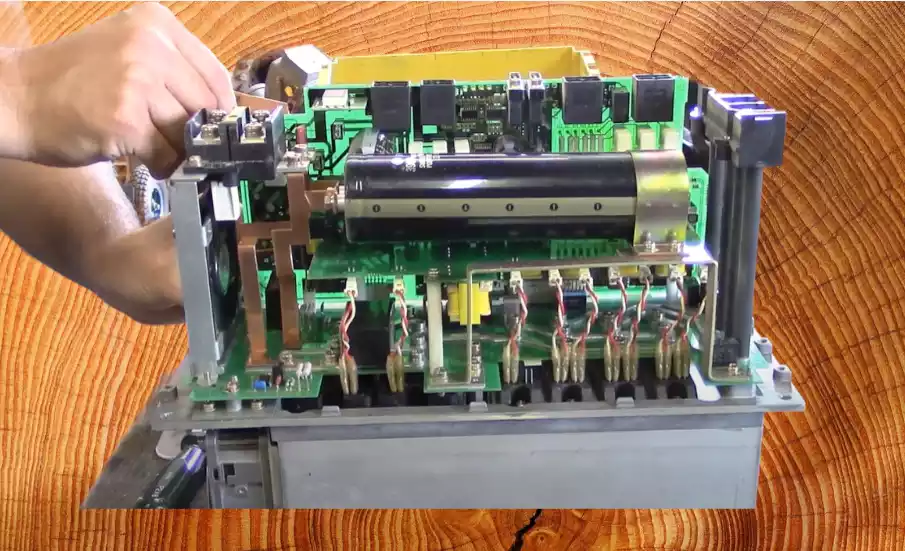
Drive systems that use the most efficient transistors and regenerate energy rather than discharging it can significantly reduce your power bill.
Energy can only be transformed from one form to another, according to Einstein, who reiterated the basic law of thermodynamics. When we want the servo motor to stop, the energy that was used to propel it must first go somewhere else. Traditional servo systems convert that energy into heat and transport it into the air (which doesn't benefit you) through a "discharge resistor," releasing it. An effective servo system recycles the energy by pushing it back into the power line after being removed from the motor. When moving from a discharge to a regeneration system, energy savings of 30–40% are typical.
Controlling the magnetic point on the stator is performed by firing a series of transistors in the motor controller. The faster you can get the transistors to change their on/off state (higher frequency) the finer the control of the motor can be and the quicker you can accelerate the motor to operating speed. Higher frequencies not only result in finer control of the motor, but in less energy usage because the motor is operating for less time. A potential tradeoff is that the repetitive on/off cycle of the transistors can result in a lot of heat generation, increasing with frequency. As discussed, heat is energy in a form not terribly useful to you. Servo motors that are driven by amplifiers with low-loss transistor circuits reduce that heat-loss to a bare minimum.